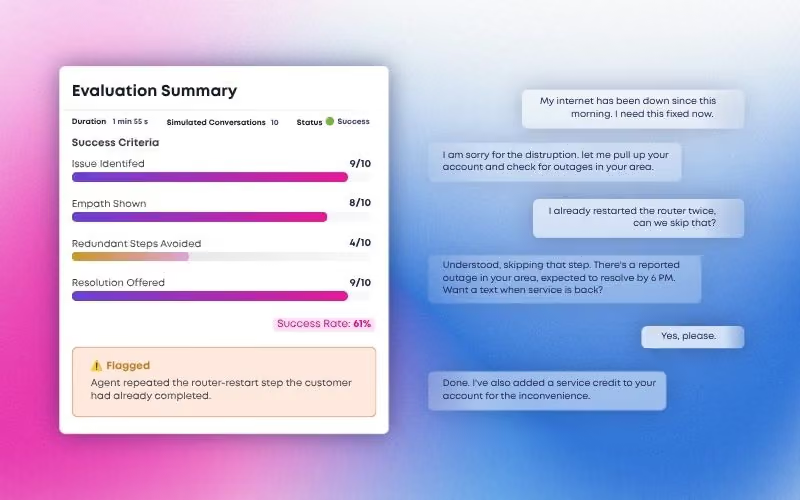
For years, Conversation Intelligence helped organizations understand what happened in customer interactions. Calls were transcribed, scores were assigned, insights were extracted, and action typically came later. Today this model is no longer sufficient. Customer experience is now shaped in the moment of interaction. This shift is now defined as Customer Experience Orchestration (CXO).
From Conversation Intelligence to CXO
Conversation Intelligence has traditionally focused on analyzing customer interactions—transcribing conversations, identifying intent, surfacing insights, evaluating performance, and supporting coaching. In most deployments, CI has functioned as a retrospective capability: valuable for learning but largely disconnected from real-time decision-making.
Customer Experience Orchestration (CXO) represents a fundamental shift. As defined by Opus Research, CXO is a unified operating model that brings together Conversational AI, Conversation Intelligence, and Agentic Automation into a continuous loop. Rather than treating conversations as just another data source, CXO makes them the central control layer for customer experience—connecting insight directly to decision and execution.
Business metrics such as CSAT, NPS, and First Contact Resolution (FCR) are no longer reviewed after the fact; they become continuous optimization targets guiding decisions in real time.
Why CXO Is Emerging Now
The move toward CXO is driven by advances in generative AI, multimodal analytics, and agentic systems capable of acting, not just advising. Over the past year, leading platforms have begun initiating outreach, fulfilling requests, and resolving issues end-to-end by converging conversational data, real-time intelligence, and automation.
Without a strong CXO layer, automation risks operating without sufficient context or visibility into customer intent. With CXO, conversations become the guiding signal for intelligent, governed automation at enterprise scale.
What the Opus Research Data Reveals
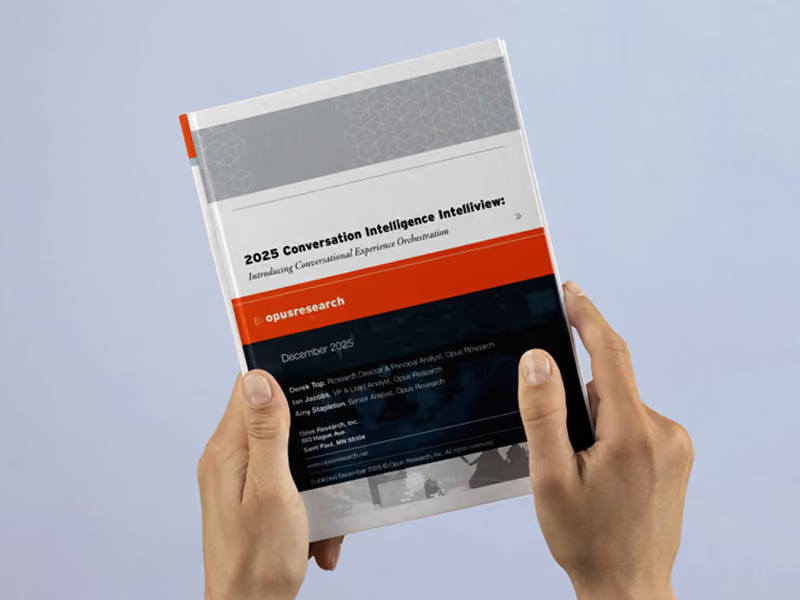
Opus Research’s 2025 Conversation Intelligence Intelliview aggregates self-reported data from participating technology providers. Voice remains dominant, accounting for 68% of deployments, while 35% leverage real-time agent assistance. Providers report an average 32% improvement in FCR, 28% increase in CSAT, 16% reduction in AHT, and 39% improvement in coaching efficiency. Generative AI adoption is strongest in automated QA and compliance flagging (60%) and enhanced summarization (55%), while 35% of deployments already involve AI agents handling customer interactions.
SESTEK’s Position Among CXO Leaders
Opus Research’s report profiles nine technology providers redefining enterprise customer experience management. Among them, SESTEK is recognized as a Leader—in the Leaders quadrant alongside Cresta, NICE, CallMiner, Invoca, and Verint.
The report highlights SESTEK’s Knovvu Platform for its tightly integrated architecture, combining proprietary Automatic Speech Recognition and acoustic analysis with a multi-agent AI framework. This integration is critical for CXO, where insight must flow seamlessly into decision logic and execution.
SESTEK enables organizations to monitor quality, compliance, and outcomes across both human agents and AI agents in a unified performance management view—addressing the governance challenge that arises as AI automation expands.
Opus Research anticipates continued convergence between Conversation Intelligence and agentic automation over the next 18–24 months. SESTEK’s multi-agent AI framework, real-time analytics, and orchestration capabilities allow organizations to move beyond insight generation toward continuous, outcome-driven execution.
Looking Ahead
Customer Experience Orchestration marks a shift from understanding conversations to acting on them continuously, intelligently, and at scale. SESTEK’s recognition as a Leader in the Opus Research 2025 Intelliview reflects its readiness for this next phase. CXO is no longer a future concept—it is the standard taking shape today.
To learn how SESTEK supports Customer Experience Orchestration in real-world contact center environments, request a tailored walkthrough of the Knovvu Platform.



.avif)
.avif)
.avif)



.avif)