Explore how next-generation Emotion AI is moving beyond basic sentiment analysis to shape customer journeys in real time, featuring insights on AI architecture, a new strategic partnership with Diagenix, and the award-wi
Tülin Ebcioğlu
SESTEK Professional Services Manager
June 26, 2026
Subscribe to newsletter
Over the past few months, we've explored how AI is transforming customer experience through agentic systems, automation and production-ready deployment. But one critical dimension of CX still remains unmeasured and underused: emotion.
Most CX systems still treat emotion as something to measure after the interaction ends. The next generation of AI responds to it while the interaction is still unfolding.
AIcan now detect frustration in a customer's tone, recognize anxiety in their word choices, and adapt its response in real time.
This is no longer basic sentiment analysis. It is emotional intelligence at scale.
The question is no longer whether AI can detect emotion. It is whether organizations are ready to act on that understanding in ways that improve outcomes, reduce escalation, and build trust.
In this issue, we'll explore:
How emotion detection works in modern CX environments
Why understanding emotion and context matters more than simply labeling it
What changes when AI can interpret and redirect emotional journeys in real time
Beyond Sentiment: What Emotion Detection Actually Means
Traditional sentiment analysis categorized interactions as positive, negative, or neutral. Emotion detection goes further by identifying states like frustration, confusion, urgency, or satisfaction in real time.
In practice, this means:
Text-based detection of emotional cues in language, punctuation, and conversation flow
Contextual mapping of how emotions evolve during an interaction
Prediction of escalation risk before a conversation breaks down
Why does this matter?
Because emotion often shapes how the customer experiences the interaction more than the words themselves.
For example:
A banking customer reporting suspected fraud needs not only a fast response, but also reassurance and trust.
A telecom customer repeating the same complaint does not only need resolution. They need acknowledgment.
A patient calling a healthcare contact center about an urgent appointment does not only need information. They need clarity delivered in a way that reduces anxiety
AI that understands emotional context can do more than improve efficiency. It can help organizations respond appropriately when trust is most fragile.
From Detection to Direction: The Three Stages of Emotional Intelligence
Leading CX organizations are moving through three distinct stages as they build more emotionally aware AI systems:
1. Detection: Knowing What the Customer Feels
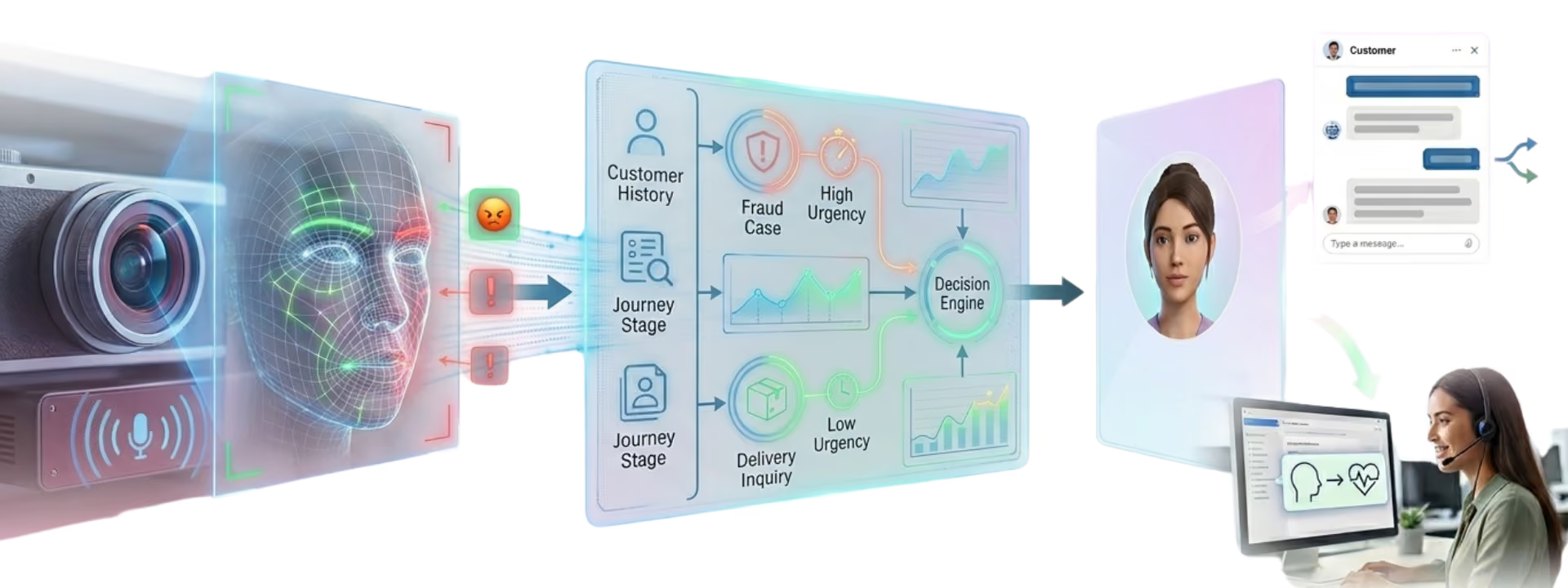
At this stage, AI detects emotional cues during the interaction. This creates value by flagging at-risk conversations, identifying escalation risk, or routing sensitive cases to more experienced agents.
2. Interpretation: Understanding Why It Matters
Emotion without context can be misleading. Urgency in a fraud case means something very different from urgency in a delivery inquiry. The real value comes from interpreting emotion alongside intent, journey stage, customer history, and channel context. Without context, emotional detection produces signals. With context, it supports decisions.
3. Direction: Shaping the Emotional Journey
This is where emotional AI becomes transformational. Instead of simply recognizing emotion, AI helps influence the direction of the interaction. In practice, it might mean:
prompting an agent to acknowledge frustration before troubleshooting
adapting virtual assistant language when anxiety is detected
accelerating escalation when distress signals pass a threshold
triggering retention workflows when disappointment appears in a renewal conversation
The strongest CX teams are no longer treating emotion as a reporting metric. They are treating it as an operational signal.
What Organizations Should Consider Before Implementing Context-Aware AI
Context-aware AI creates meaningful new opportunities, but it also introduces operational complexity. Before scaling these capabilities, organizations should ask a few critical questions:
Do you have the right escalation protocols in place?
If AI detects panic, distress, or severe frustration, the response must be immediate and well-defined. Without clear escalation rules, detection creates visibility but not resolution.
Are your agents equipped to act on emotional insights?
Real-time emotional cues are only valuable if agents know how to act on them. Agents need training, prompts, and workflows that translate signals into effective action. "This customer is frustrated" is information. "Acknowledge the issue first, then offer solutions" is guidance. Training must evolve alongside technology.
Is your system calibrated for language and culture?
Emotional expression varies across geographies, cultures and languages. A signal that suggests anger in one context may be normal emphasis in another. Systems need to reflect the realities of the markets they serve, not just the assumptions of the model.
Can you balance empathy with privacy?
Emotional data is sensitive. Organizations need to be transparent about what is being detected, how it is used, and how it is governed. Trust depends on responsible design.
The companies that succeed here will not be the ones that simply detect emotion. They will be the ones that operationalize it responsibly.
The Real Reason for Succes in Agentic AI Projects: Design Architecture
McKinsey & Company's "State of AI" research conducted across 105 countries clearly reveals a critical gap in AI investments: 88% of companies use AI, yet only 6% generate real, measurable business value.
Agentic AI projects are rapidly moving from the experimental stage into production environments. However, only a small fraction are able to create measurable business value. The problem here is not the model or the platform — it's how we design the system to behave in the real world, in other words, the design architecture.
In production environments, Agentic AI systems don't just generate responses; they interpret intent in real time, operate across different systems, handle ambiguity, and make sound decisions under unpredictable user behavior. The majority of failures stem not from a lack of technology, but from the absence of the architectural layer that governs these behaviors.
At SESTEK, we address this problem through our AI Agent Design Architecture. This framework brings together system integration, conversational and decision flows, prompt logic, and context interpretation into a single design layer.
When this architecture is properly established, agents become not just conversational systems, but structures capable of consistent decision-making,delivering stable performance and tangible business outcomes in production.
— Ekin Ayaşlı, Senior Business Analyst & Consultant, SESTEK
SESTEK Agentic CX Event: The Future of Customer Experience
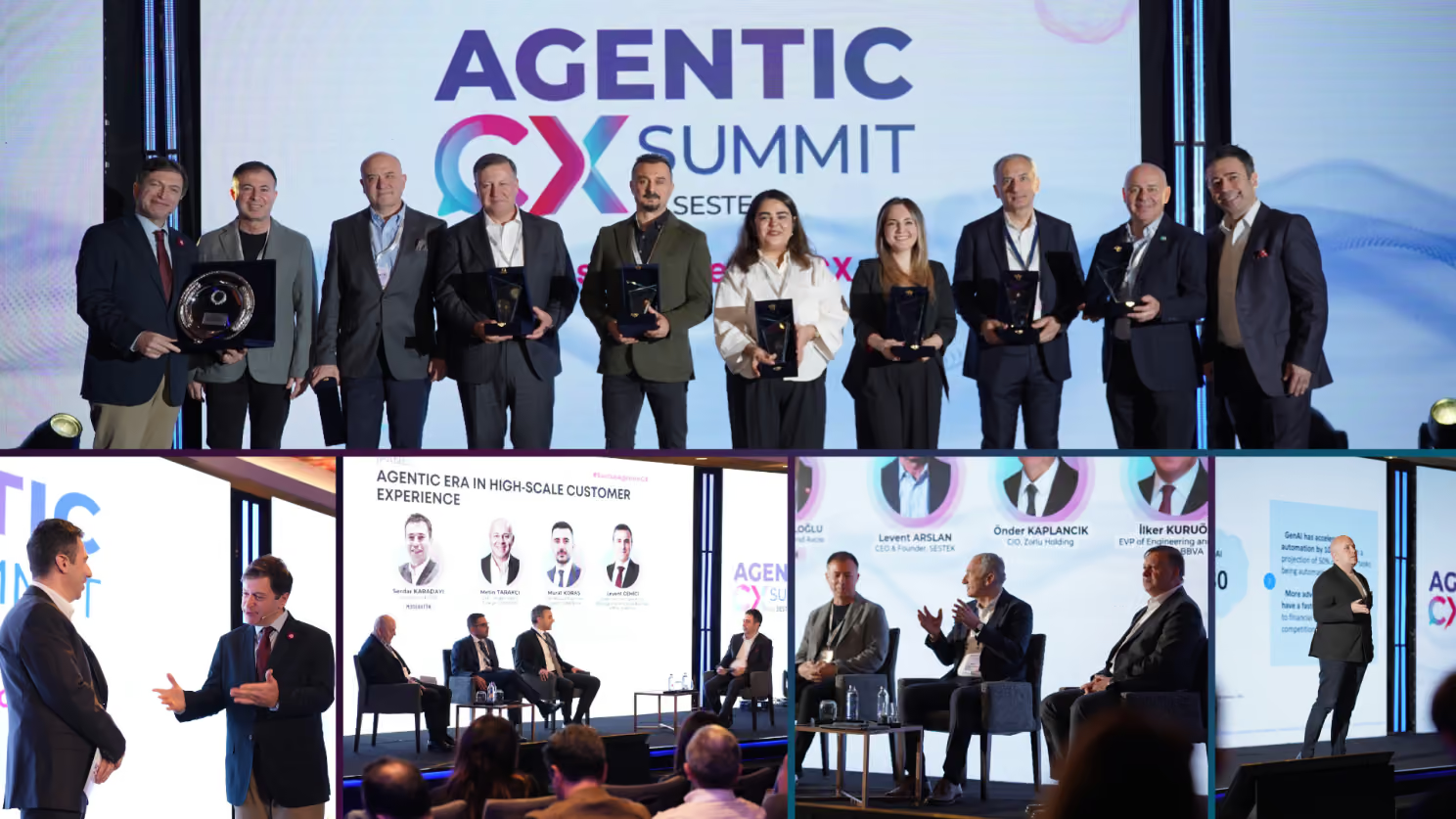
The SESTEK team recently hosted an exclusive Agentic CX event. After four years, this gathering brought together customer experience leaders, technology innovators, and industry experts to explore how Agentic AI is reshaping customer interactions.
The event featured live demos, panel discussions, and success stories. Attendees gained practical perspectives on how organizations can balance automation with human oversight as they transition toward more autonomous, outcome-driven customer experience operations.
SESTEK Partners with Diagenix for Advanced AQM & Analytics
SESTEK has announced a strategic partnership with Diagenixto deliver enhanced Automated Quality Management (AQM) and Analytics capabilities. This collaboration combines SESTEK's conversation intelligence and speech analytics expertise with Diagenix's advanced quality assessment and conversational consulting frameworks.
Together, the partnership offers high impact, actionable insights for enterprises using existing their customer conversations. Within weeks customers can expect executive level insights and findings around CX breakdowns, top customer automation opportunities, identification/authentication friction points.For CX leaders, this means an actionable plan for CX transformation and roadmap for your automation strategy in the contact center.
Breaking Barriers: AI That Understand Every Child's Voice
SESTEK's Breaking Barriers project has been recognized as an official success story on the Eureka Network platform following its completion under the European Union's Eurostars programme.
The project addressed a critical challenge: many children with disabilities communicate in ways that traditional speech recognition systems struggle to understand.
In collaboration with SmileandLearn, SESTEK developed an AI-powered e-learning platform capable of understanding children’s speech with 96% accuracy, including voices previous technologies failed to process effectively.
The platform supports children with visual, motor, or intellectual impairments and autism spectrum disorders, and is available in Turkish, English, and Spanish.
This reflects to broader principle at the heart of emotionally intelligent AI: meaningful understanding begins when technology adapts to people as they are not as it expects them to be.
A Question Worth Asking
As you evaluate your customer experience technology roadmap, consider this: Are you measuring customer satisfaction after interactions end — or are you building the capacity to respond while interactions are still unfolding?
That is the difference between analysis and intelligence.
If emotion-aware AI is becoming a priority for your organization, the real question isn't whether your systems can detect emotion. The question is whether your workflows, teams, and governance models are ready to act on it responsibly.
In the Next Issue
The future of customer experience won't be determined by how quickly AI can resolve issues. It will be shaped by how well it understands and responds to the human experience within those interactions.
Emotion detection is just the beginning. Emotional intelligence is the destination.
👉 What CX topic should we explore in the next issue?
Follow SESTEK on LinkedIn and join the conversation. See you next month! 👋



.avif)

.avif)
.avif)