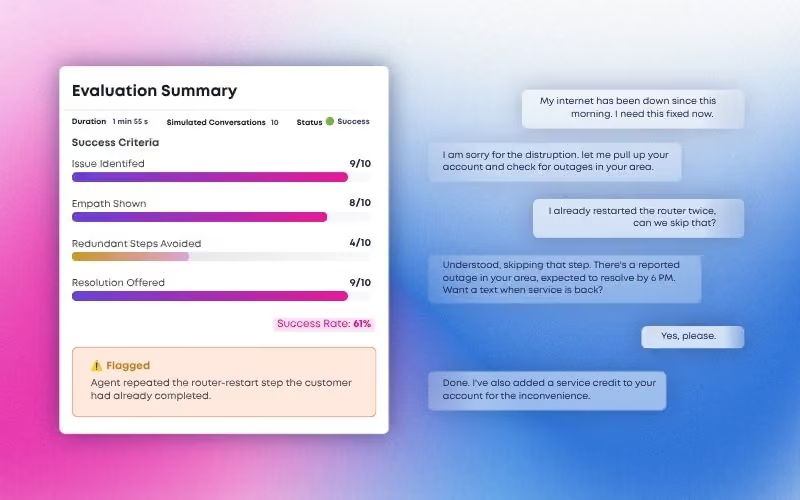
Contact centers have long been viewed as a cost line item on the balance sheet. Yet the most emotional and decisive contact between the customer and the company often happens here. Today, this field is under pressure from three directions: customers expect 24/7, uninterrupted, and instant solutions; senior management positions AI investments as a strategic priority; and consumers are more open to AI-powered services than ever before.
With demand, pressure, and acceptance all present simultaneously, one would expect brilliant results. However, according to Gartner’s June 2025 Report, more than 40% of Agentic AI projects will be abandoned before reaching production by the end of 2027. Behind these failures lies a recurring pattern: starting without clear goal definitions, going live without backend system integration, expecting optimization without collecting performance data, and ignoring the human factor.
SESTEK’s Approach: Hybrid Autonomy
In late 2024, a paradigm shift began from rule-based virtual assistants toward goal-oriented autonomous agents capable of reasoning and taking action. SESTEK read this signal early, launched its Agentic AI platform in early 2025, and agents quickly began working with real customers in production environments.
The platform is built on a multi-agent architecture where specialized agents—each with their own knowledge sources and toolsets—share tasks under supervisor coordination. The specialized multi-agent architecture distributes cognitive load, localizes changes, and makes testing and scaling sustainable.
One of the platform’s most critical features is the ability to run different levels of autonomy together on a single platform. The hybrid autonomy model runs rule-based scenarios, RAG-supported knowledge base queries, and autonomous agent decision mechanisms together within the same session. For sensitive steps like payment confirmation or identity verification, the AI Agent automatically switches to a pre-validated workflow; once the transaction is complete, it returns to autonomous mode while preserving context.
Voice’s Harsh Test
Voice agent projects may look flawless in demo environments. But in the real world, the voice channel is the true stress test of architecture. A two-second wait tolerated in chat can create a “system not working” perception on the phone.
The voice experience consists of a three-layer latency chain: SR (Speech Recognition), agent reasoning, and TTS (Text-to-Speech). The weakest link determines the entire experience. The most critical link is speech recognition—a system that mishears the customer cannot reach the correct result, no matter what you put behind it. In real contact center conditions—under different accents, line noise, and codec losses—SESTEK achieved an accuracy rate exceeding 97%.
Lessons from the Field
Build specialist agents, not one giant agent. When switched to a multi-agent structure, each specialist works with clear, concise instructions and the error rate drops visibly. When problems arise, only the relevant agent is updated—the need to test the entire system is eliminated.
Build an intelligent search layer instead of dumping data into the model. The agent can never make up data—it only chooses from a verified list. This is the most critical rule.
Trust the model, but always verify. Language models can sometimes say “done” without actually completing the transaction. Deterministic validation layers that confirm each critical step has really been completed are essential.
Adapt to the customer, don’t impose format. For capturing structured data like phone numbers: try all at once first; if that fails, switch to piecemeal mode; if that fails, transfer to a representative.
Manage latency through design. Stream agent responses token by token, sending them to the TTS engine without waiting for the complete response. Pull customer records in the background as soon as a call begins, so the agent grasps context before the customer explains the issue.
Conclusion
The transformation promised by Agentic AI is real. But what wins in production is not the organization that uses the biggest model; it’s the one that systematizes the speed of learning. Real success is not the moment you give the right answer; it’s the moment you can recover safely when you misunderstand. Because trust is built as much on recovery capacity as it is on accuracy.
Author: Mert Çıkan, Lead Product Owner at SESTEK



.avif)
.avif)
.avif)





.avif)