A recent McKinsey study across 105 countries reveals a striking paradox: while 88% of companies are already using AI, only 6% are generating business value from it. Gartner adds another critical layer: only 14% of customers fully resolve their issues through self-service channels.
These numbers do not point to a failure of technology. They point to a failure of implementation. The platforms are powerful, the models are capable. Yet in production, they fail to deliver the expected outcomes. At SESTEK, we’ve seen this pattern repeatedly—and we know exactly where the gap lies.
A Strong Foundation Is Essential — But Not Enough
What determines how the system behaves in real life—how it communicates, responds, and integrates into business processes—is architecture. This is where the AI Agent Design Architect comes in. Technology builds the system. Architecture turns it into value.
Where Do Projects Fail?
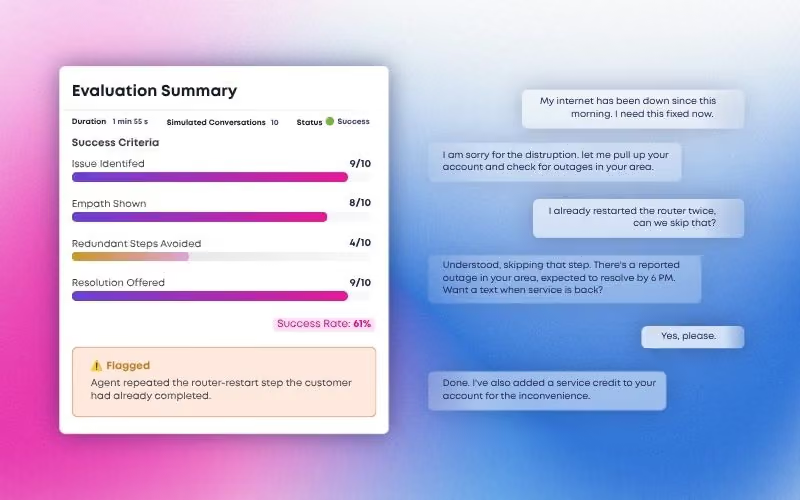
- Designed for Ideal Users — Not Real Ones: In demos, everything works perfectly. Real users interrupt, change topics, use incomplete sentences, or express frustration. If the system cannot interpret emotional cues, it misses the real intent. The result: higher escalation rates, lower completion rates, and invisible ROI.
- Data Is Connected — But Not Understood: If the model is not guided on how to interpret data, the system may respond correctly—but take the wrong action.
- The Tone Is Wrong: Sometimes the system gives the right answer—in the wrong way. Too formal, too cold, too generic. If a frustrated customer receives a flat mechanical response, trust breaks even if the answer is technically correct.
What SESTEK AI Agent Design Architects Do Differently
At SESTEK, we unify all design layers under a single role with a full-system perspective:
- Early Risk Analysis: We analyze how and where scenarios may break in production before development begins.
- Designing for Real Users: Deviation points—incomplete speech, wrong words, emotional states—are embedded into flow logic, prompts, and fallback behaviors.
- Prompt and Language Architecture: Word choice, sentence order, and confirmation phrasing either build or silently erode user trust.
- Escalation and Handoff Diagnosis: “The system escalates too much to agents” usually means the system cannot tolerate ambiguity or fails to build sufficient trust.
- Data Preparation and Integration: Raw inputs must be transformed into a format that models can understand. The agent can never make up data—it only chooses from a verified list.
- Industry Context and Language: When an insurance customer reports a claim in an emotionally exhausted state, the system’s ability to detect this and adjust its tone builds trust.
Architectural Decisions Define Project Outcomes
Consider two projects: same platform, same model, similar budget. One goes live within months and delivers measurable business value. The other struggles with high escalation rates, low completion metrics, and user dissatisfaction. All of these differences are architectural decisions. And their quality directly determines business outcomes.
At SESTEK, we deliver this transformation in every project—with a 100% delivery rate.



.avif)
.avif)
.avif)





.avif)