AI is becoming part of critical business operations, from customer service and fraud detection to banking, telecommunications, and public services. But as adoption accelerates, so does the need for stronger security, transparency, and governance.
For enterprises, the question is no longer only whether a solution uses AI. It is whether that AI technology is built, deployed, and managed in a way that protects sensitive data, supports regulatory compliance, and gives organizations control over how their systems operate.
Why AI Security Starts from Day One
IBM’s 2025 Cost of a Data Breach Report points to a growing “AI oversight gap,” noting that 63% of breached organizations studied had no AI governance policies in place. The report also found that 97% of organizations that experienced an AI-related security incident lacked proper AI access controls. McKinsey’s 2026 research on AI trust reaches a similar conclusion: security and risk concerns have become one of the biggest barriers to scaling AI.
That’s why security can’t be added after an AI solution is already deployed. Organizations need to know how the model is trained, where the data is processed, which third-party dependencies exist, and how the system can be audited and controlled.
SESTEK’s Security-First AI Approach
At SESTEK, security isn’t treated as an external layer added after implementation. It’s part of how we design, develop, deploy, and govern our AI technologies.
Not a Black Box: Built by SESTEK
SESTEK develops and manages its core speech technologies in-house. Our speech recognition and text-to-speech technologies are built internally, reducing dependency on third-party APIs and giving enterprises greater transparency over the technologies they use.
Sensitive Voice Data Stays Inside
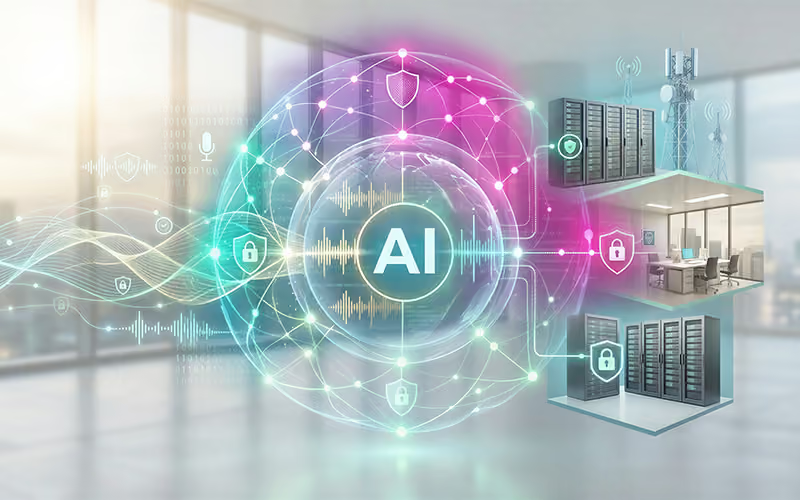
SESTEK can offer speech recognition in an on-premise architecture, which means voice data can be processed within the organization’s own infrastructure without leaving its environment. This is critical for banking, finance, telecommunications, and public services.
Private Cloud for Enterprise Security
In Turkey, SESTEK can build organization-specific private cloud environments and security frameworks aligned with internal security policies and local regulatory requirements, including KVKK for personal data protection and BDDK requirements for the banking sector.
Offline LLM for Regulated Industries
For highly regulated sectors such as banking, SESTEK addresses data sovereignty concerns with offline LLM capabilities. The model can operate without an internet connection, ensuring customer data doesn’t leave the controlled environment and making the model selection fully auditable.
Data Masking as a Core Layer of Secure AI
SESTEK supports data masking at two levels: dynamic masking (hidden from users, original remains in database) and static masking (permanently removed from the transcript with no option to restore). This distinction is especially important for the financial sector.
Certified Security and AI Governance
SESTEK holds ISO 27001, ISO 27017, ISO 27018, and ISO 9001 certifications. In 2026, SESTEK also completed the ISO 42001:2023 Artificial Intelligence Management System audit for the first time, with no minor or major nonconformities—demonstrating organizational maturity in responsible, transparent, ethical, and secure AI management.
Secure AI Starts with Trusted Technology
As AI becomes more embedded in enterprise operations, security must be part of how technology is built, deployed, and governed. SESTEK helps enterprises adopt AI with greater confidence through in-house technologies, flexible deployment models, data protection capabilities, and a security-first approach to AI governance. Get in touch with SESTEK to learn more.



.avif)
.avif)
.avif)



.avif)