AI agents already generate more Internet traffic than humans, and the gap keeps widening at a dizzying speed.
In the "Agentic World," a customer's AI Assistant talks directly to a company's AI Agent, with no human on either end.
Gartner expects multi-agent AI systems to outperform human teams by 2030, yet warns that 60% of agent project failures will repeat 1998 mistakes.
Governance, security, maturing protocols like MCP and A2A, and humans "in the loop" and "on the loop" decide whether agentic AI succeeds.
Constant evaluation and guardrails are paramount to preventing hallucinations and out-of-scope actions by AI agents.
AI agents now create more Internet traffic than humans, and the gap keeps widening. A new pattern is emerging: a customer's AI Assistant talking directly to a company's AI Agent, with no human on either end. In that world, humans do not disappear. They move to the role that matters most: deciding, auditing, and keeping control.
Who is generating the Internet's traffic now?
AI agents are literally everywhere on the Internet. This year, Human Defense Platform released a report on the digital interactions created across the globe in 2025. The numbers are overwhelming, yet the simple truth is crystal clear: the Internet traffic created by AI agents exceeded the traffic created by humans. According to the report, the traffic generated by AI agents and agentic browsers grew 7,851% year over year, and it keeps increasing at a dizzying speed. AI agents are communicating with each other more than ever, in every type of use case.
Customer service is one of the favorite stages of AI agents, where they are gradually becoming leading actors. In self-service channels, the use of LLMs began with understanding the intention of a human customer and rapidly evolved into agentic behavior, where they act and decide on behalf of a human agent. AI agents have since taken their side in the conversational space across industries, mainly finance, IT, telecom, healthcare, and retail. I call this "Chapter 1" of the agentic era.
In this world, the design principles of conversational agents are shaped by parameters like latency, token consumption, and re-use of AI agent skills. Such conversational applications have become multi-agent AI systems. Gartner foresees that by 2030, multi-agent AI systems will outperform human teams and legacy AI in speed, accuracy, and reliability. This sounds exciting, doesn't it?
Why do agentic AI projects keep failing?
Let's not get too excited. Gartner also predicts that legacy mistakes will be repeated. Surprised? Probably not, if you are familiar with this domain. Gartner's report plainly states that through 2030, 60% of agent project failures will repeat 1998 mistakes: poor expectations, flawed design, integration issues, and system dysfunction. Another Gartner report identifies the cancellation reasons of agentic AI projects as unclear value proposition, escalating costs, and governance gaps.
The ecosystem keeps expanding, too. Ascendix published a report estimating that there were 90,000 AI companies worldwide as of 2025, and after almost a year, we can assume this number has grown even more. Vendors, end users, and AI agents inflate all types of statistics. Where do we go from here? Certainly to "Chapter 2."
What happens when both ends of a conversation are AI?
I call "Chapter 2" the "Agentic World," where both ends of a conversation are played by AI agents. Here, both parties act on behalf of a human. To clarify the roles, it may be more accurate to call the client's AI agent an "AI Assistant" and the serving agent the "AI Agent." The AI Assistant has a task to get done, be it an inquiry or a transaction.
But hold on a minute. Is there ever a conversation here? By definition, a conversation is a talk between two or more people in which news and ideas are exchanged. If both ends of a communication channel are not occupied by people, what type of communication is this?
Today, Model Context Protocol (MCP) and Agent-to-Agent (A2A) enable agent collaboration across platforms, though not perfectly. Gartner sees these emerging technologies as still immature, with evolving standards and open challenges in semantic consistency, security, and reliability. Security was always a concern, but it is more worrying than ever with the news of AI systems penetrating enterprises' data systems.
So, will "Chapter 3" tell an apocalyptic story?
Can we avoid the agentic AI apocalypse?
Not necessarily. We can, but only if we act on what we already know. We know where AI projects failed before, are failing now, and will fail tomorrow. Ironically, history seems to repeat itself in the agentic AI world, too. Nothing is surprising here, simply because we as humans created this technology and are implementing it. The recipe is in our hands, and it decides how "Chapter 3" will be written.
Firstly, AI companies and anyone who wants to use AI no longer question whether to implement governance. In the past, project discussions tended to prioritize functional requirements over non-functional ones, which were considered only if the deal was likely to be signed. Now, this is changing. Prospects ask security and governance questions in the first round of discussions.
Secondly, providers of agentic AI-based solutions are investing effort in MCP and A2A protocols, because the future of communication between AI agents will be all about them. This may help build a standard, controllable, and reliable communication medium among AI agents.
Where do humans fit in?
This to-do list for a successful implementation and a satisfying user experience can be extended. However, there is one undeniable fact: the human factor. "Human-in-the-loop" is a well-known phrase that emphasizes the auditor role of humans in a multi-agent AI system. Humans should also be the mastermind of the overall solution, often called "human-on-the-loop," to prevent misapplications of hyped technologies.
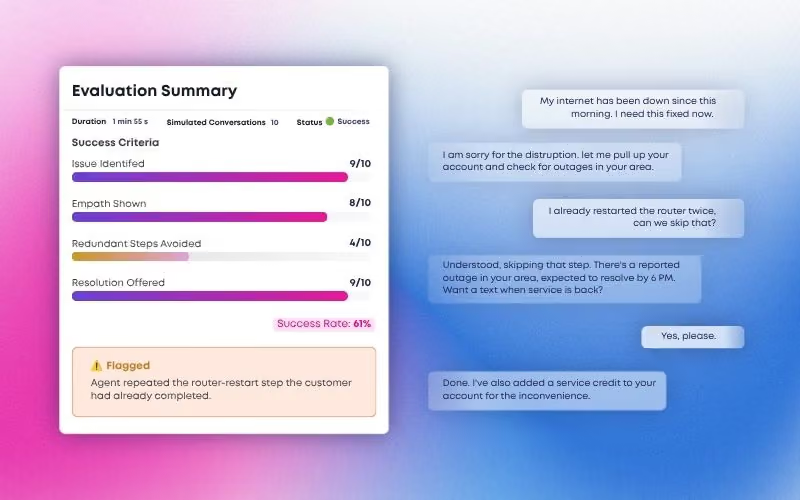
In a world where human-generated communication traffic will be the minority, hallucinations and out-of-scope actions can bring catastrophe to people's lives. Consider a banking AI Assistant applying for a credit loan that the actual bank customer never intended to take. Constant analysis, AI agent evaluation, and guardrails are paramount to avoiding regretful implementations. Domain expertise and the ability to fix vulnerabilities swiftly will differentiate AI software vendors from the rest.
The world population is more than 8 billion. We don't know exactly how many AI agents are out there. Microsoft said there are nearly 40 million agents registered. Nevertheless, they are creating more traffic on the Internet than we do. The Internet is pretty crowded.
So, if you want to step into this world, or you have already started experimenting with it, you'd better have a trusted partner as a guide to show you the safe, secure, and easy way.
Talk to our team to build your agentic AI strategy; Request a demo
Share
More blogs from SESTEK
Who Really Sets the Price of AI?
SESTEK Lead Product Owner Mert Çıkan explains that the cost of an AI system is decided by how it is built, not by the rate written into the contract, and shows what three changes to the way control and context move between agents did for a live production deployment.
Understanding Generative AI: The Possibilities and the Pitfalls
In this article, we'll dive into large language models, exploring their key advantages, potential issues that might arise when relying solely on them for customer service, and practical solutions to maximize their effectiveness.
SESTEK President Serdar Karadayı explains why AI's real battleground is now experience, not intelligence, and how 25 years in speech technology led to voices so natural that users mistake them for real people.
The acquisition provides Unifonic with immediate access to Sestek’s suite of cutting-edge “Conversational AI and Analytics” solutions and a strong base of existing clients and partners.
Agentic AI: Works in Demo, Can it Survive in Production?
SESTEK Lead Product Owner Mert Çıkan shares why AI agents that look flawless in demos fail in production, and how SESTEK overcomes these barriers with hybrid autonomy.
The Reasoning Era of Conversational AI: From Understanding to Action
SESTEK Project Manager Rami Izhiman explores how Conversational AI is moving beyond speech recognition and predefined scenarios toward reasoning, contextual understanding, and decision-making.
Explore why secure enterprise AI projects require more than standard testing, and see how SESTEK helps organizations reduce deployment risks while securing sensitive customer data at scale.
The Rise of AI-Powered Virtual Agents in E-Commerce
Discover how AI-powered virtual agents transform e-commerce customer experience and operations while exploring how SESTEK's Knovvu Virtual Agent enables leading retailers to deliver fast, personalized, 24/7 support at scale.