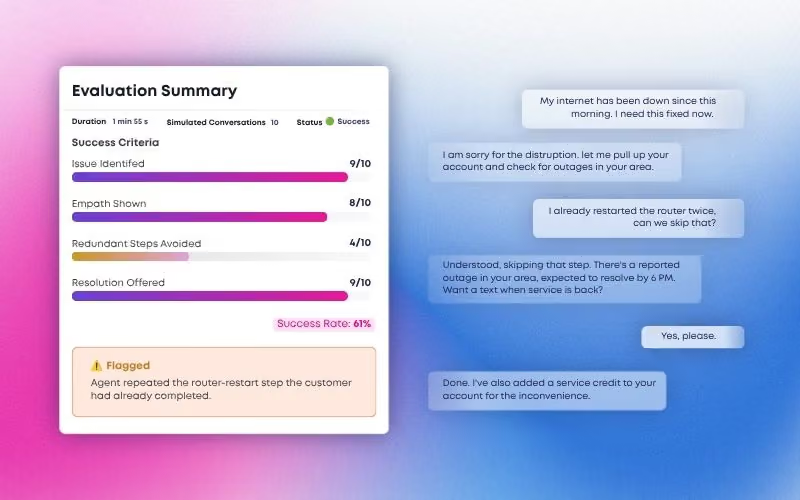
As AI moves from experimentation to expectation, it holds immense promise for businesses. Yet despite significant investments, many AI projects fail to deliver meaningful business value. The real challenge isn’t AI itself, but how AI projects are planned, executed, and scaled in real-world environments.
This blog post explores why AI projects fail, the common challenges organizations face in real-world scenarios, and how SESTEK drives successful AI implementations, with a specific focus on conversational AI, agentic AI, and speech technologies.
AI Failure Isn’t Rare
Research consistently shows that up to 85% of AI projects fail. Gartner’s 2025 report reveals more than 50% of generative AI initiatives fail, often due to poor data quality, unclear objectives, or misaligned expectations between business and technology teams.
They all share a common pattern: AI often works in theory but fails in practice when real-world complexity is ignored.
Top Reasons Behind AI Project Failures
1. Lack of Clear Strategy and Goals
Many organizations adopt AI because it’s trending, not because it solves a defined business problem. Deloitte’s 2024 State of AI report highlights that while 74% of organizations invest in AI, many struggle to realize value because they treat AI as a science experiment rather than a business solution.
2. Poor Data Quality and Governance
AI is only as good as the data it learns from. Studies show that 63% lack proper data management practices for AI. Imagine a bank deploying an AI agent to answer loan inquiries—if the agent pulls information from three unsynchronized legacy systems, it may provide different interest rates in the same conversation, instantly eroding customer trust.
3. Weak Integration and Scaling
AI often performs well in controlled environments, but it can break down in real-world settings unless integration is planned from day one. Proofs of concept often succeed in isolation but fail in production because they don’t integrate with existing workflows, CRMs, or operational systems.
What Makes an AI Project Successful
McKinsey’s 2025 report shows that organizations creating real value prioritize agents, innovation, transformation, and clear KPIs. Workflow redesign stands out as a top differentiator.
1. Data Readiness: Ensure high-quality, diverse datasets. For conversational AI, this means including different accents, languages, and contexts.
2. Alignment with Business Goals: Define ROI metrics early. For example, agentic AI should automate clearly defined tasks such as call routing or case resolution.
3. Ethical and Risk Frameworks: Address privacy, bias, and compliance from day one, not after deployment.
4. Organizational Alignment and AI Adoption: Educate stakeholders and enable cross-functional collaboration between business, IT, and AI teams.
5. Scalability and Iteration: Start with pilots, monitor performance, and scale gradually while managing data drift and operational risks.
The Blueprint for AI Success
1. Define a Clear Use Case and Success Metric: Gartner reports that 63% of high-maturity organizations rigorously track ROI for every AI project.
2. Build a Strong Data Foundation: Data strategy must come before model selection. For agentic AI, this also means providing a reliable knowledge base through retrieval-augmented generation (RAG).
3. Put Humans at the Heart of the Process: McKinsey’s “superagency” approach emphasizes using AI to amplify human capability.
4. Validate Use Cases and Scale with Care: Choose pilots based on impact rather than novelty. Start small, prove ROI, then scale. Redesign workflows around AI instead of forcing AI into existing processes.
5. Implement Governance and Ongoing Monitoring: Without continuous oversight, even well-performing models can degrade over time.
6. Prioritize Security and Ethics: Gartner notes that 91% of high-maturity organizations have dedicated AI leaders focused on governance and risk management.
SESTEK’s Strategy to Reduce AI Failure Risk
At SESTEK, we design conversational AI, agentic AI, and speech technologies with a clear focus on real-world deployment, not theoretical autonomy. Instead of treating autonomy as a default, SESTEK applies it deliberately. AI systems are designed to understand goals, reason through options, and take action within clearly defined boundaries.
Security, governance, and data responsibility are built in from day one. Sensitive information is protected, guardrails are enforced, and AI behavior remains aligned with enterprise policies. Backed by more than 25 years of AI R&D and deep expertise in speech and language technologies, SESTEK helps organizations move beyond pilots and build AI solutions that scale, integrate, and deliver lasting business impact.
Contact our team to build AI solutions that move beyond pilots and create measurable impact in production.



.avif)
.avif)
.avif)




.avif)