Discover how the "Agentic Shift" is transforming customer experience from passive AI support to active workflow execution, and learn how organizations can successfully balance autonomy, governance, and human collaboratio
Selin Karadayı Özbalmumcu
SESTEK Sales Director
June 26, 2026
Subscribe to newsletter
Over the past year, AI’s role in customer experience has changed considerably. It is no longer limited to answering questions summarizing interactions or surfacing insights after the fact. AI is now guiding workflows, coordinating actions across systems, and in some cases executing tasks on its own.
That is the real meaning of the Agentic Shift.
The question is no longer whether AI should support CX teams. It is how organizations design the right balance of autonomy, oversight, and collaboration as AI becomes more active in day-to-day operations.
In this issue, we explore:
• What the Agentic Shift really means in practice • How CX teams are adapting • What organizations should put in place before scaling agentic AI further
Enjoy the read,
Selin Karadayı Özbalmumcu, SESTEK Sales Director
What Agentic Shift Actually Means
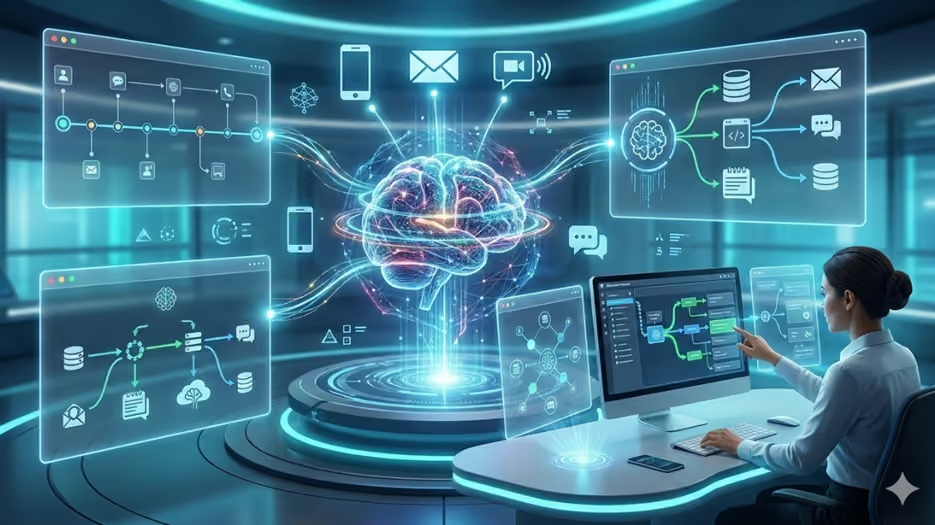
Agentic AI refers to systems that can plan tasks, reason through steps, and execute actions across multiple tools or workflows. In CX environments, this shift is already visible:
• AI systems coordinating multiple tools to resolve customer issues • Virtual agents triggering follow-up actions across channels • Real-time assist platforms guiding agents through complex workflows • AI recommending next-best actions during interactions
This is not simply automation on a scale. It is a structural shift in how decisions, tasks, and responsibilities are distributed between humans and machines. For CX leaders, the challenge is no longer whether agentic systems will appear but how CX teams adapt to working effectively alongside them.
As AI capabilities expand, the role of human agents is evolving. Agents are no longer just resolving customer issues, they are increasingly supervising AI actions, validating recommendations, and stepping in when empathy or judgment is required.
Three clear shifts in leading CX organizations:
1. Agents as AI Supervisors
Agents monitor AI-driven workflows and intervene when necessary, instead of executing every step manually. This makes visibility and control critical. If agents cannot understand what the AI is doing, trust breaks down quickly.
2. AI as Decision Partner
Real-time insights, predictive prompts, and context-aware recommendations transform AI into an active collaborator rather than a passive tool. Used well, this reduces effort and speeds resolution. Used poorly, it creates noise, overrides, and confusion.
3. Dynamic Customer Journeys
With AI acting across systems, journeys are no longer fixed scripts. They adapt in real time based on context, behavior, and intent. This creates flexibility, but also increases the need for governance, context continuity, and clear escalation paths.
The strongest teams are not treating this as a technology shift alone. They are redesigning how work gets done.
What Organizations Should Consider Before Scaling Agentic AI
The promise of agentic AI is real. But scaling it successfully requires more than adding autonomy.
In practice, most challenges appear in the gaps between systems, teams, and decisions. Organizations should ask a few hard questions before expanding agentic workflows:
Do you have clear boundaries for AI autonomy?
Some workflows can be fully automated. Others require approval checkpoints, escalation rules, or controlled handoffs. Without defined boundaries, autonomy can create risk faster than value.
Are your teams prepared to supervise AI effectively?
As AI becomes more active, agents need more than prompts. They need visibility into why decisions are being recommended, when action has been taken, and how to override or adjust the flow when necessary. Are your systems connected enough for agentic execution?
Many initiatives stall here. The AI may be capable, but the surrounding environment is fragmented. Disconnected workflows, inconsistent data access, and weak orchestration layers make reliable execution difficult.
Is governance maturing alongside the technology?
When AI starts acting across workflows, accountability matters. Monitoring, auditability, performance tracking, and fallback design become critical.
Organizations that succeed in the agentic era do not simply deploy more AI. They design human + AI collaboration intentionally.
SESTEK Blog: Agentic AI: Works in Demo, Can it Survive in Production?
Gartner predicts that over 40% of agentic AI projects will never reach production by 2027. Not because the technology isn't ready—but because organizations aren't.
Agentic AI is rapidly moving from concept to reality. What once impressed in controlled demos is now being tested in production environments, where complexity is unavoidable and the stakes are higher. The promise is compelling: autonomous agents that can reason, plan, and act across workflows. But the real challenge begins when scalability, reliability, and control become non-negotiable.
Demos impress. Production environments tell the truth.
This is where many discussions around Agentic AI become misleading. Demos often make autonomy look simple. Production environments are not simple. In real operations, organizations need to balance speed, control, customer trust, and existing investments.
At SESTEK, we anticipated this shift early and launched our Agentic AI platform in 2025. Yet production reality introduces constraints—single large agents bring context limitations, rising costs, and maintenance complexity. And replacing mature, functioning systems entirely is neither practical nor sustainable.
Our hybrid autonomy model bridges this gap—combining rule-based flows, retrieval-based knowledge(RAG), and autonomous decision-making in one platform. Gradual adoption. Existing investments protected. Production-ready AI, on your terms.
The agentic shift is already visible in real customer environments.
Vodafone
Vodafone one transitioned to SESTEK’s Analytics and Speech-to-Text solutions, enabling customer interactions to be captured, transcribed, and analyzed at scale. This kind of speech and analytics foundation matters because agentic systems are only as effective as the quality of the context and insight they operate on.
Ajman Bank
Ajman Bank deployed a bilingual, human-like AI Avatar powered by SESTEK’s Virtual Agent technology to enhance customer engagement across digital banking channels. The value was not just in creating a more advanced interface, but in delivering a more natural, contextual, and continuous customer experience across digital touchpoints, essential for adaptive, agentic customer journeys.
Analyst Recognition
Industry recognition is also reinforcing this direction. SESTEK has been recognized among only nine global players in the Opus Research 2025 Conversation Intelligence Report. The report evaluates leading vendors delivering AI solutions that transform customer conversations into action, not just analysis. This reflects the growing importance of turning insight into execution, which is exactly what agentic systems are designed to do.
Together, these examples point to the same conclusion: the Agentic Shift is not theoretical. It is already influencing how organizations design modern CX operations.
As AI becomes more active in your CX environment, are you simply adding more automation, or are you redesigning how humans and AI work together?
That is where the next level of value will come from.
If you would like to review how your current CX workflows are evolving, and where agentic capabilities can be introduced with the right balance of control and impact, SESTEK would be glad to explore that with you.
Looking Ahead
The Agentic Shift is already underway and CX teams are at the center of this transformation. The future of CX will not be defined by automation alone but by how effectively organizations orchestrate collaboration between humans and intelligent systems.
👉 Which CX topic should we explore in the next issue?
Follow SESTEKon LinkedIn and join the conversation.



.avif)

.avif)
.avif)