In February 2024, a finance worker at a multinational firm was deceived into transferring $25 million to fraudsters using deepfake technology to pose as the company’s chief financial officer during a video conference call. The elaborate scam involved the worker attending a video call with what he believed were several other members of staff, all of whom were deepfake versions.
As AI technology advances, deepfakes are becoming increasingly sophisticated, making it harder to distinguish between what is real and what is fake. In this blog post, we’ll explore what deepfakes are, discuss why they pose a growing threat, and examine how SESTEK combats deepfakes by leveraging its expertise and continuous R&D efforts.
What is Deepfake?
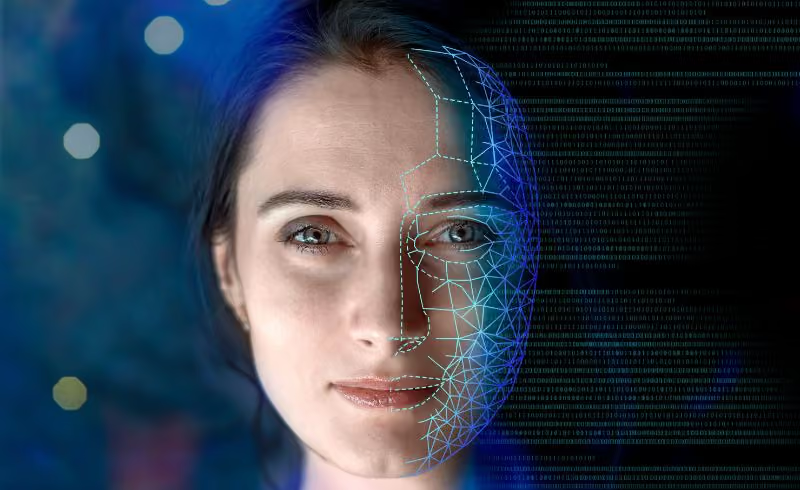
Deepfake technology uses artificial intelligence (AI) to create highly realistic fake audio, video, or images by learning patterns from real content and generating manipulated versions that are hard to distinguish from the original.
Deepfakes can be used to spread misinformation, impersonate people, or even trick biometric security systems by mimicking voices or faces. For instance, attackers may create fake voices to impersonate customers or executives, leading to unauthorized access or fraudulent transactions.
Why Is Deepfake Becoming a Bigger Threat?
Deepfakes are becoming more sophisticated, accessible, and widespread, making them an even greater security risk.
One key reason is that deepfake technology is constantly improving. Generative AI-powered deepfakes use self-learning systems that continuously refine their ability to bypass detection. Additionally, AI models can now replicate a person’s voice with as little as three seconds of audio — down from at least 30 minutes a few years ago. This rapid advancement lowers the barrier for attackers, making deepfake scams more accessible to a wider range of threat actors.
Beyond individual attacks, deepfake fraud can now scale. With Generative AI, bad actors can target multiple victims at the same time using minimal resources. Social media further amplifies the problem: once a deepfake spreads online, it becomes harder to control or debunk.
Deepfake Threats Demand Smarter and Stronger Defenses
Deepfakes don’t follow traditional fraud patterns. They mimic voices and faces with near-perfect accuracy, making it difficult to detect using standard security measures.
Gartner advises organizations to work with vendors that offer advanced capabilities for detecting and addressing emerging threats, including deepfakes.
Forrester warns that deepfake prevention shouldn’t be seen as a one-time fix. Instead, businesses must recognize it as an ongoing risk and allocate resources to stay prepared. This includes combining AI-driven verification with additional security layers to prevent fraud and account takeovers.
SESTEK’s Advantage: Strengthening Security with R&D
At SESTEK, our deep expertise in voice technologies enables us to develop highly effective voice biometrics solutions to combat these challenges. Our R&D team is continuously testing the latest technologies and refining our own solutions, allowing us to stay ahead of emerging threats and outperform competitors.
Our commitment to R&D has made SESTEK a leader in deepfake detection. In a recent test, our R&D team compared our model’s accuracy against a competitor specializing in this field, using a dataset of approximately 2,000 samples. This dataset included widely used deepfake sources such as “In the Wild” datasets, Azure TTS, and our proprietary SESTEK Voice Conversion method. At a 1% false alarm rate, our model achieved a 90.6% detection accuracy, significantly outperforming our competitor’s 69.2% accuracy.
Our technology consistently delivers results that surpass many models and systems in the industry. As deepfake technology evolves, so do fraud tactics. That’s why we continuously refine our solutions through rigorous testing and ongoing development, ensuring we remain at the forefront of deepfake security.
Contact us for a demo and discover how our advanced biometrics solutions can safeguard your business against emerging security threats.
Authors: Yusuf Sali, R&D Engineer & Debi Çakar, Product Owner at SESTEK



.avif)
.avif)
.avif)




.avif)