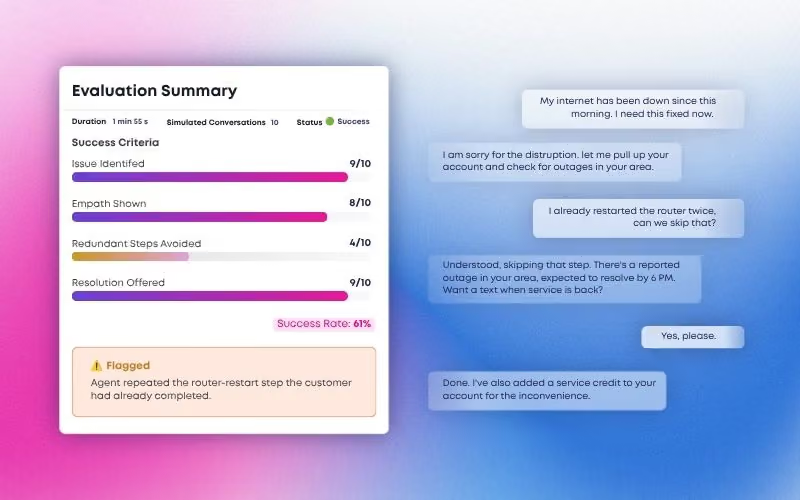
Virtual agents have become integral parts of our daily lives, powered by advancements in AI, including Natural Language Processing (NLP), Machine Learning (ML), and Speech Recognition (SR). They significantly enhance user productivity and provide invaluable benefits for businesses by automating self-service, reducing costs, and increasing overall efficiency.
In this blog post, we will delve into the fundamentals of virtual agents. We will explore what virtual agents are, how they operate, the several types available, and their diverse use cases across various industries. Let’s dive in!
What is a Virtual Agent?
A virtual agent is a software application designed to engage in human-like conversations with users, assisting them in performing tasks or obtaining the information and support they require. There is often overlap between virtual agents, chatbots, and virtual assistants, which leads to these terms being used interchangeably. However, they can be distinguished based on their specific technological aspects.
A chatbot is a program that simulates real-time human conversation with users, primarily through text interactions. While some advanced chatbots use AI, many rely on a decision tree flow and pre-programmed responses, which makes them well-suited for handling basic customer service tasks such as answering frequently asked questions (FAQs).
The term virtual assistant traditionally refers to a human providing remote assistance. However, it also applies to AI-powered software, also known as voice assistants or digital assistants. These technologies automate actions that users would typically perform themselves.
Virtual agents are advanced systems that utilize conversational AI to not only understand what users say but also interpret their intentions, providing solutions that meet their expectations. These agents continuously learn and improve over time, enhancing performance and user experience. Designed to automate complex tasks such as bill payments or updating login credentials, virtual agents extend business operations and significantly increase efficiency.
How do Virtual Agents work?
Virtual agents combine technologies such as NLP, ML, SR, and text-to-speech to interact with users naturally.
Users can communicate with virtual agents via text or speech. When using speech, the virtual agent first employs speech recognition to convert spoken words into text. It then applies NLP to understand the message, including its meaning and intent. Subsequently, the virtual agent processes this information, often utilizing ML to continually enhance its accuracy, and generates an appropriate response.
For voice interactions, text-to-speech technology converts the response back into spoken words. This blend of technologies allows virtual agents to understand and respond to user queries effectively and naturally.
Types of Virtual Agents
1. Rule-based Virtual Agents
Rule-based virtual agents operate according to predefined rules and scripts. They excel in handling simple and straightforward tasks but do not possess the ability to understand natural language or learn from interactions. These agents are commonly employed for basic customer service inquiries, where responses follow clear and structured patterns. For instance, an e-commerce platform might utilize a rule-based virtual agent to address questions regarding shipping, returns, and order status.
2. AI-powered Virtual Agents
AI-powered virtual agents harness AI-based technologies such as machine learning (ML) and natural language processing (NLP) to understand and respond to queries in a more natural, human-like manner. They excel in engaging in complex conversations and comprehending user intents, making them suitable for diverse applications ranging from customer service to personal assistants. For instance, a financial institution could deploy an AI-powered virtual agent to assist customers with tasks such as investment advice, loan applications, and fraud detection.
3. Hybrid Virtual Agents
Hybrid virtual agents merge the strengths of rule-based systems with AI-powered capabilities to maximize efficiency and cost-effectiveness. Predefined rules efficiently manage routine queries, while AI-backed features handle more complex requests. For instance, hybrid virtual agents are adept at assisting customers with account-related inquiries in a bank call center.
4. Voice-enabled Virtual Agents
Voice-enabled virtual agents come in two primary forms: personal assistants, like Siri and Alexa, which enable users to interact through speech; and conversational IVRs (Interactive Voice Response), which manage customer queries over the phone. These agents can understand and respond to questions without human intervention. For instance, a telecom company might use a voice-enabled virtual agent to efficiently handle inquiries related to billing, technical support, and sales.
Applications of Virtual Agent Across Different Sectors
Customer Support: Virtual agents are commonly used as automated customer service representatives across multiple channels, including the web, social media platforms, and messaging apps. By offering 24/7 customer service, they significantly reduce the workload of human agents by managing frequently asked questions, offering essential technical support such as password reset and device configurations, and addressing common queries like account information, troubleshooting steps, and order statuses.
Sales and Marketing: In sales and marketing, virtual agents engage potential customers on websites and social media platforms, qualifying leads and forwarding them to sales teams. They offer personalized product or service recommendations based on user preferences and behavior, thereby enhancing the shopping experience.
E-commerce: In e-commerce, virtual agents streamline order management by assisting users in tracking orders, managing returns, and handling cancellations. They also serve as shopping assistants, guiding users through the website, helping them find products, and facilitating the completion of purchases.
Human Resources: In human resources, virtual agents guide new employees through the onboarding process, including document submission and initial training. They reduce the workload of HR personnel by addressing frequent questions about policies, benefits, and procedures.
Healthcare: In the healthcare sector, virtual agents offer patients essential medical information regarding conditions, treatments, and medications. They assist patients in scheduling, rescheduling, or canceling appointments with healthcare providers.
Banking and Finance: In banking and finance, virtual agents assist customers with account services such as checking balances, reviewing recent transactions, and transferring funds. They also serve as personal finance consultants, providing basic financial advice and information on services such as loans, credit cards, and investment options.
Travel and Hospitality: In the travel and hospitality industry, virtual agents assist users in booking flights, hotels, and rental cars, and help them manage their itineraries.
Education: In educational institutions, virtual agents support students with tasks such as course registration, scheduling, and academic advising. They offer supplementary educational materials and respond to questions about coursework.
In conclusion, virtual agents play crucial roles in enhancing efficiency and user experience across various industries. Leveraging their capabilities can lead to significant benefits for both users and businesses.
Leverage your self-service with super agents
For more information about Sestek’s virtual agent solutions, check out the Knovvu Virtual Agent page.
Calculate the potential savings for your organization using our Virtual Agent cost savings calculator.
Request a demo today to explore how to boost user experience and operational efficiency with Knovvu Virtual Agent.



.avif)
.avif)
.avif)





.avif)