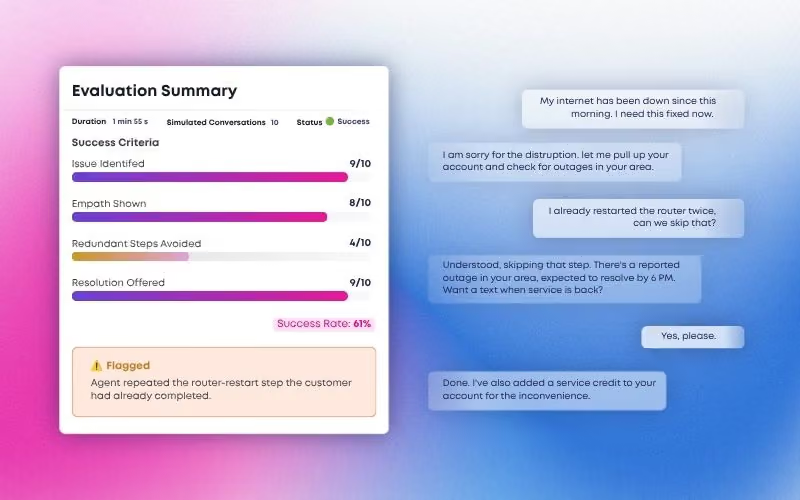
Virtual agents, also known as virtual assistants, chatbots, or digital assistants, are transformative tools that enhance customer service through conversational AI technology.
Call centers, which play a vital role in customer service, leverage virtual agent technology to automate self-service, increase efficiency, reduce costs, and provide an enhanced customer experience. In this blog post, we will explore the primary benefits that virtual agents offer to call centers.
1. Cost Efficiency
An intelligent virtual agent helps resolve customer queries at the source, routing them to live agents only when necessary. This dramatically reduces the number of tickets or interactions that human staff need to manage, especially for routine questions and simple interactions such as password resets, scheduling appointments, or order tracking.
By streamlining customer interactions, virtual agents reduce the dependency on a large support team. This optimization allows human agents to focus on complex queries where a personal touch is crucial, rather than repeatedly answering the same questions. Additionally, virtual agents assist live agents in performing their tasks more efficiently. For example, they can provide agents with a detailed summary before connecting them to the customer, ensuring a smooth transition and enhancing the customer experience. They can also help with after-call work, reducing the time agents are unavailable.
Automation ensures high-quality service, decreasing the workload of live agents and reducing the need for a larger team. Enhanced customer service leads to shorter call durations and faster resolutions, positively impacting operational costs. All these factors contribute to a crucial benefit: cost efficiency.
2. Uninterrupted 24/7 Services
Today’s customers expect to receive services whenever they need them, not just during business hours. Offering 24/7 customer service can be challenging, requiring additional in-house staff, or outsourcing to other call centers. This is where virtual agents come into play.
A virtual agent is available around the clock and can handle various tasks, from answering routine questions to providing basic technical support. For more complex issues, the virtual agent can schedule a callback from a live agent during business hours. By providing 24/7 service, virtual agents contribute to faster issue resolution with shorter response times and swift support. Uninterrupted services are especially crucial for global companies that may not have the budget to hire agents for every time zone. Virtual agents, unrestricted by service hours, can automatically manage queries even when the physical call center is closed or operating with fewer agents.
3. Ability to Assign Agents to More Important Tasks
For many teams, routine tasks such as answering simple questions, directing customers to the appropriate channels, or sharing basic information can be time-consuming and divert call center agents’ attention from more critical tasks.
Integrating virtual agents into call centers allows them to manage routine requests, freeing up employees to apply their expertise to more complex tasks and manage a higher volume of interactions. For example, agents can focus on strategic initiatives such as identifying the root causes of common customer complaints or engaging in personalized interactions to build stronger relationships. When live agents can concentrate on more important tasks, they are more motivated and less burdened by repetitive, monotonous work. This results in improved agent performance and better customer experience.
4. Shorter Wait and Resolution Time
Virtual agents expedite digital transformation by managing routine tasks and frequent questions, reducing the need for live agents to handle every interaction. This eliminates the need for customers to wait on hold for the next available agent. Timely service contributes to first-call resolution, enhancing the customer experience, improving KPIs, and lowering call center operating costs.
Many virtual agents utilize conversational AI and natural language processing (NLP) to engage in human-like interactions. NLP improves the customer experience by understanding not only what customers say but also their intended meaning, while AI continuously enhances performance. With each interaction, AI learns and adapts, enabling the virtual agent to provide an increasingly satisfying customer experience.
5. Enhanced Customer Experience
Fast responses are essential for today’s customers, who dislike spending minutes on hold. Virtual agents eliminate long wait times by enabling customers to self-serve. Customers can instantly engage with virtual agents and receive solutions to their needs.
Advanced AI capabilities enable virtual agents to deliver personalized experiences by utilizing historical data from previous interactions. They can use personal details like names and locations to create more natural and relevant interactions.
The primary benefits of virtual agents include immediate assistance, reduced wait times, improved first-call resolution, and tailored services. These factors significantly enhance the customer experience, leading to increased satisfaction and potential retention, as customers favor brands that provide superior experiences.
In summary, virtual agents offer significant advantages to call centers by improving cost efficiency, ensuring uninterrupted 24/7 service, allowing agents to focus on critical tasks, reducing wait and resolution times, and enhancing the overall customer experience. Leveraging advanced conversational AI technology transforms call center operations, enabling superior customer service and greater operational efficiency. Adopting virtual agents is a strategic choice for any call center seeking to remain competitive and meet the evolving expectations of today’s customers.
Transform your call center with virtual agents
For more information about SESTEK’s virtual agent solutions, check out the Knovvu Virtual Agent page.
Calculate the potential savings for your organization using our virtual agent cost savings calculator.
Request a demo today to explore how to boost user experience and operational efficiency with Knovvu Virtual Agent.



.avif)

.avif)
.avif)





.avif)